


What Is Brass?
Definition and Composition of Brass
Brass is an alloy of copper and zinc, to which further elements such as aluminium, iron or nickel can be added depending on the desired properties. The composition influences colour, hardness and other material properties: a high copper content creates a golden-orange colour, while more zinc results in a light-yellow appearance. Brass is non-magnetic, somewhat harder than pure copper, but not as hard as bronze. It is characterised by good corrosion resistance, excellent machinability, formability and thermal conductivity.

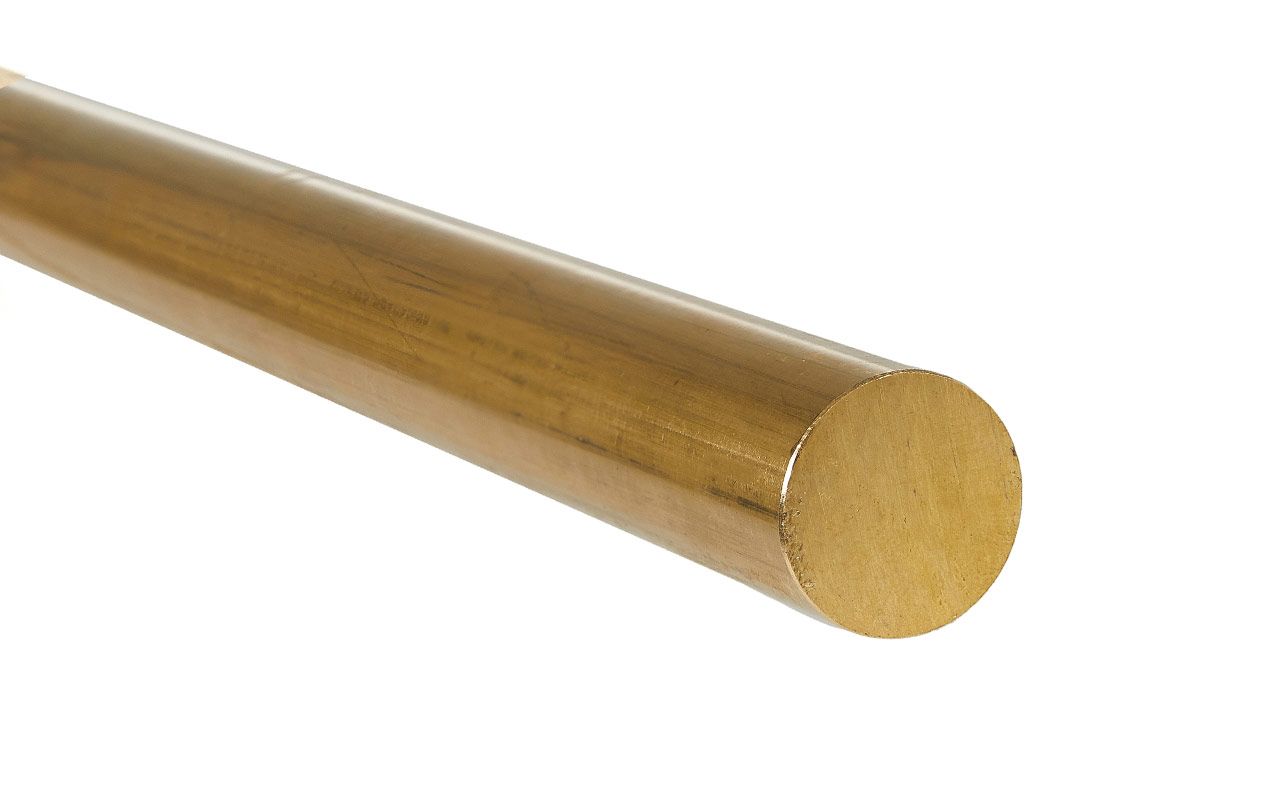


The Most Important Facts About Brass at a Glance
- Copper-zinc alloy: Brass mainly consists of copper and zinc; depending on the composition, colour, strength and processability change.
- Characteristic properties: Non-magnetic, harder than pure copper, good electrical and thermal conductivity as well as antimicrobial due to the copper content.
- High corrosion resistance: Very resistant to moisture and many chemicals – ideal for sanitary applications, shipping and outdoor use.
- Easy to process: Can be excellently sawn, drilled, milled, soldered, forged or cast; free-cutting brass with lead content offers particularly good machinability.
- Versatile use: Used, among other things, for fittings, connectors, tubes, electrical plug connectors, gears, cartridge cases, signs as well as jewellery and decorative parts.
Properties and Colour
The colour of brass varies depending on the percentage of the metals. A high copper content gives brass a golden appearance, while a high zinc content creates a light-yellow colour. Brass is harder than pure copper, but softer than bronze (an alloy of copper and tin). Brass parts can be easily joined with other materials, whether by soldering, screwing or bonding. In addition, the smooth surface is easy to maintain and can be cleaned simply with warm water. The melting point is usually in the range of about 900 to 950 degrees Celsius, depending on the alloy, and tends to decrease as the zinc content increases.

What Types of Brass Are There?
Brass includes a wide variety of alloys (roughly around 60 variants in total). The key factors are primarily the copper and zinc content: copper is the minimum component, while zinc is added in different proportions depending on the desired property. As the zinc content increases, not only the colour changes, but also strength and processability. A zinc content of up to around 50 percent is common, as the material becomes more brittle above this level. A common example is CuZn37 with 37 percent zinc. In addition, further elements can specifically change the properties.
Special Brass and Free-Cutting Brass
- Special brass: Contains additional alloying elements such as aluminium, iron, manganese or tin, for example, to improve certain properties such as strength, corrosion behaviour or castability.
- Free-cutting brass (machining brass): Usually contains a small amount of lead to improve machinability and enable precise parts to be manufactured efficiently.
Advantages of Brass
- Corrosion resistance: Brass is extremely resistant to moisture and many chemicals, making it ideal for use in sanitary applications, shipping or outdoor areas.
- Good machinability: The material can be easily sawn, drilled, milled, polished and formed. Lead-containing brass alloys are especially ideal for producing complex components with tight tolerances.
- Durability: The material is very robust and withstands high mechanical loads without losing its shape.
- Antibacterial properties: Thanks to its copper content, it is antibacterial, which makes it especially interesting for applications in healthcare and the food industry.
- Good electrical and thermal conductivity: That is why it is often used for electrical connections.
- Attractive appearance:The warm, golden colour also makes the material popular for decorative purposes.
Classification by Processing Type
Cold-Forming Brass
Cold-forming brasses are characterised by the fact that they are particularly well suited to cold forming and are often processed into semi-finished products such as sheets/strips, brass wire or thin-walled tubes. Typical alloys contain approx. 5–37 % zinc (e.g. CuZn36/CuZn37). Depending on the cold deformation, they are available from soft to spring-hard.
Hot-Forming Brass
Hot-forming brass is designed for processing at higher temperatures and is particularly well suited to hot forming. It can be forged very well and is used, among other things, for bars, profiles, wires and tubes, including in extrusion processes.
Casting Brass
Casting brasses are suitable for cost-effective series production and for components with more complex geometries. Additives such as aluminium or silicon, for example, can improve mould filling and castability. Typical processes include die casting, permanent mould casting or centrifugal casting.
Examples: Brass Types and Typical Use
- Tombac: Often used for jewellery, decorative applications and arts and crafts (copper-rich, rather reddish). Gold tombac is a tombac variant that is especially popular for jewellery and ornamental parts because of its gold-like colour.
- Gold brass: Often used for brass instruments (good acoustic properties).
- Sheet brass: e.g. for finer metal goods, partly also in watchmaking/mechanics production.
- Talmi gold: Inexpensive jewellery (not “real” gold brass, often plated).
- Yellow brass casting: For cast small parts and decorative parts (classic casting applications).
- Special brass: For structural components when increased strength or special properties are required.




FAQ – Frequently Asked Questions About Brass
Is brass considered a copper alloy?
Yes. Brass is based on copper as the main metal, with zinc and, if required, additional elements added to specifically influence properties such as strength, corrosion resistance or appearance.
Which processing form is suitable for hot forming brass?
For forming at higher temperatures, specially adapted alloys are used that can be forged well or formed into bars, profiles and tubes using the extrusion process.
What significance does calamine have in the history of brass?
In the past, a naturally occurring zinc ore was used which, when heated together with copper, enabled the production of early brass alloys and therefore served as an important raw material.
Why is lead added to some brass types?
A small addition of this element significantly improves machinability, making turning, drilling and milling easier and allowing very dimensionally accurate components to be manufactured economically.
How does brass differ from red brass in terms of structure and use?
While the former alloy mainly consists of copper and zinc, the latter is usually a casting-optimised material; differences in the microstructure lead to different strengths and typical applications, for example in fittings or moulded parts.